For large enterprises such as banks, healthcare networks, government entities, airports, educational campuses, and PSUs, Electric Vehicle (EV) Charging Stations are far more than simply installing chargers in various locations. The real challenge lies in integrating EV charging seamlessly with existing electrical infrastructure, renewable energy systems, operational continuity requirements, energy management, digital intelligence platforms for user access and payments and more over central monitoring and control.
At Unicorn SV (USV), we approach EV charging infrastructure as an integrated energy ecosystem — combining Solar PV, intelligent Energy Management Systems (EMS), UPS-backed continuity, and secure cloud-based monitoring platforms to create scalable, resilient, and future-ready charging environments.
Key Components of Integrated Energy Ecosystem:
- DC /AC Fast Chargers
- Solar PV System
- Grid Supply (Primary Source)
- UPS System (Power Continuity)
- Energy Management System (EMS)
- Cloud-Based Monitoring Platform.
- Progressive Web App

Key Components of an Integrated EV Charging Infrastructure
1. DC /AC Fast Chargers
DC/AC Fast Chargers form the core user-facing infrastructure, enabling rapid charging for fleet vehicles, employee transportation systems, public access charging, or operational mobility requirements.
For enterprise environments, charger selection shall consider: future scalability, demand diversity, simultaneous usage patterns, utility limitations and cybersecurity compliance.
2. Solar PV Integration
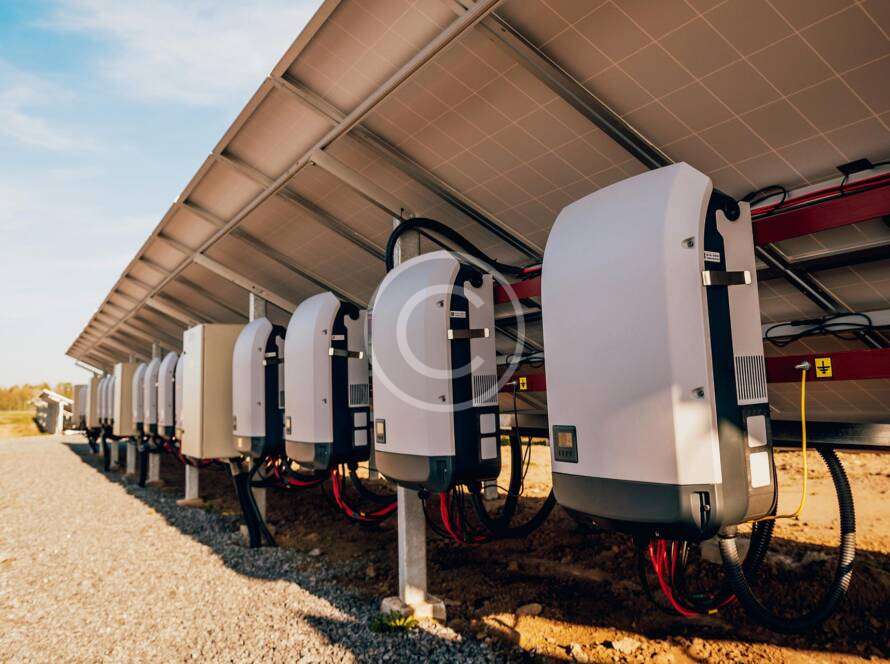
Integrating Solar PV systems with EV charging significantly improves sustainability performance while reducing operational energy costs.
During daytime operation, solar generation can directly offset charging demand, helping organizations:
- Reduce grid dependency,
- Improve ESG metrics and Carbon Reduction
- Lower carbon footprint,
- and Enhance energy resilience.
3. Grid Supply as the Primary Energy Backbone
While renewable integration is important, grid power remains the primary source. Engineering design must therefore account for: utility capacity availability, transformer sizing, diversity factors, peak demand management, harmonic impact, and future expansion capability.
4. UPS Systems for Power Continuity
In sectors such as banking, healthcare, telecom, airports, and government operations, charging infrastructure often supports operational continuity requirements.
5. Energy Management System (EMS)
The EMS acts as the intelligence layer of the entire infrastructure ecosystem. A properly designed EMS continuously monitors and optimizes: charger loading, solar generation, grid import/export, energy consumption patterns, and operational efficiency.
For enterprise clients, EMS integration transforms EV charging from a standalone utility expense into a strategically managed energy asset.
6. Secure Cloud-Based PWA Platform
Modern EV charging ecosystems increasingly require centralized digital visibility across multiple facilities and locations. This is where secure cloud-based PWA (Progressive Web App) platforms become highly valuable.
Unlike conventional mobile applications, PWA platforms provide: app-like user experience, browser-based accessibility, secure cloud connectivity and cross-device compatibility. For corporate and government environments, PWA-based systems can provide:
- Centralized monitoring and availability tracking,
- Energy Analytics,
- Alarm Notifications and Maintenance workflows,
- User Authentication and Payments
- and ESG Performance Reporting.
Enabling the Future of Sustainable Mobility
As organizations move toward net-zero and electrification targets, EV charging infrastructure will become a critical component of modern facility ecosystems. However, the future belongs not merely to charging infrastructure — but to intelligent, connected, resilient, and sustainability-driven energy platforms.
By integrating EV charging with Solar PV, EMS intelligence, UPS-backed continuity, and secure digital platforms, enterprises can transform mobility infrastructure into a long-term strategic energy asset.